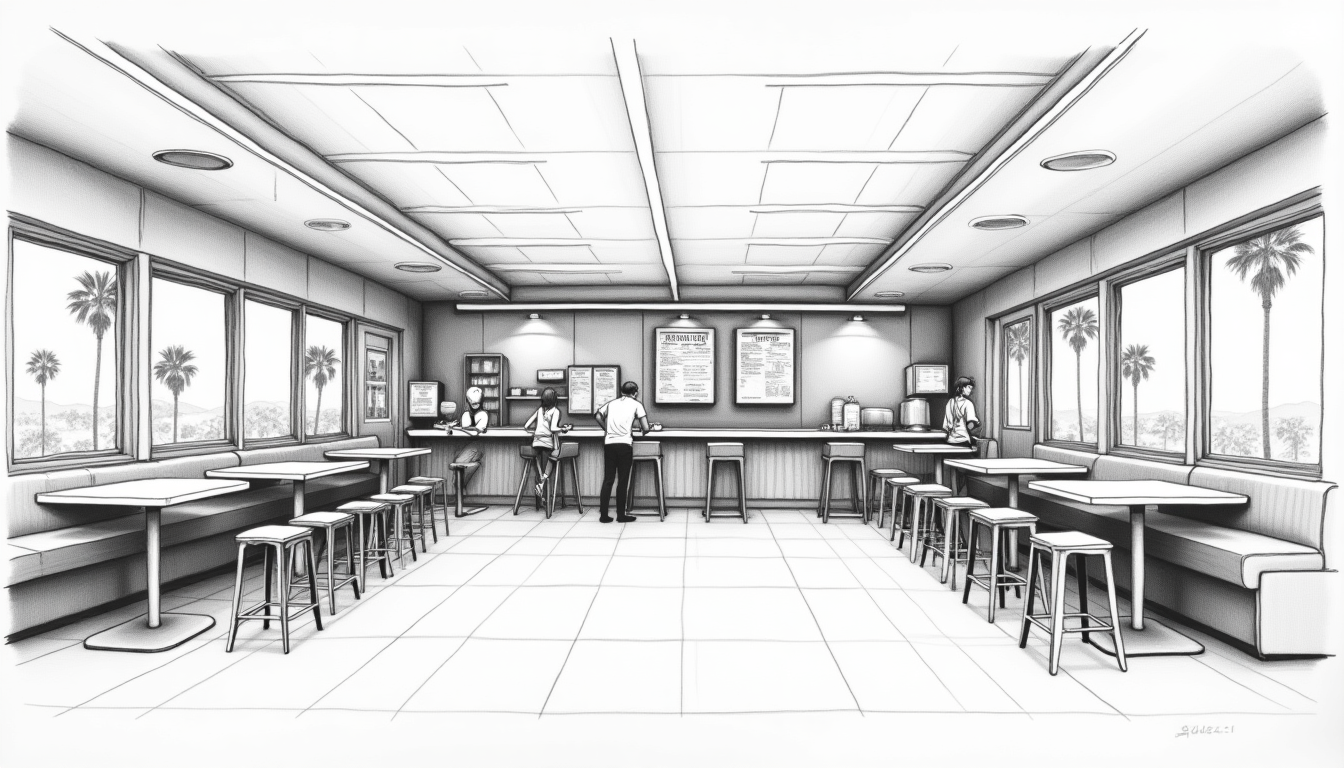
25 Degrees, the burger room inside the Hollywood Roosevelt Hotel at 7000 Hollywood Boulevard, posted news of its closure on Instagram on Wednesday, May 6, 2026, after operating since 2005. The Instagram note framed the closure plainly, saying that “it’s become increasingly difficult for hotel restaurants in Los Angeles to operate sustainably. Rising costs, new regulations, and decisions made at the City Council level made it harder and harder to keep going.” The room was one of eight restaurants, bars, and lounges inside the Roosevelt and ran the late-night burger-and-milkshake daypart for two decades.
A 21-year hotel-restaurant institution closing in tourist-corridor Hollywood is one fact on its face. The closure statement is the operating signal worth tracking for SoCal coastal operators reading this cycle.
What the closure statement is saying
When a 21-year operator’s closure note names “rising costs, new regulations, and decisions made at the City Council level” in the same breath, the operator is pointing at a specific regulatory cost stack rather than generic margin compression. The City of Los Angeles passed the Citywide Hotel Worker Minimum Wage Ordinance on May 14, 2025, signed by Mayor Karen Bass on May 27, 2025. The ordinance sets a $25.00 per hour wage floor effective July 1, 2026 for hotels with more than 60 guest rooms, with a separate minimum toward health benefits, stepping to $27.50 in 2027 and $30.00 in 2028. The Hollywood Roosevelt, anchoring the Hollywood Boulevard tourist corridor, sits inside that coverage radius.
Enforcement is currently suspended pending a June 2026 referendum, after the LA Alliance for Tourism, Jobs and Progress submitted more than 140,000 signatures, exceeding the 93,000 required. The American Hotel & Lodging Association characterized the wage move as an “economic tsunami” in a May 20 letter to the mayor and estimated “at least 15,000 jobs and the loss of hundreds of millions in critical tax revenue” at risk. Whether the ordinance survives the ballot or not, the regulatory uncertainty is the operating context every LA hotel-attached F&B operator is making lease, staffing, and reinvestment decisions inside right now.
A hotel restaurant signed against 2018 unit economics, running the late-night daypart with a high labor line, is sitting at the front of that cost stack. The 25 Degrees closure says the operator who built that room across two decades reached a number where the cycle stopped penciling.
The broader cost stack the closure is sitting on
The National Restaurant Association’s 2026 State of the Industry release reported that 42% of operators said their restaurant was not profitable last year and 60% reported softer customer traffic, with more than nine in ten flagging food, labor, insurance, energy, and swipe fees as significant challenges. The number of independent restaurants in the United States declined 2.3% in 2025, a net loss of about 9,500 locations. California’s general state minimum sits at $16.90 effective January 1, 2026, with the LA hotel ordinance layered on top of that floor for properties in the coverage band.
Hotel-attached F&B operators are the sub-segment most exposed to this stack. The non-arm’s-length restaurant lease is built around hotel-program economics, the rent isn’t negotiated against unit margin, and the wage line is set by ordinance rather than against the operator’s P&L. A free-standing burger operator on a triple-net lease can flex pricing, hours, or daypart. A hotel restaurant inside a property above the 60-room threshold is locked into the hotel’s operating program and the city’s regulatory program at the same time, and that combination is the operating envelope 25 Degrees just exited.
The SoCal Coastal Read
The regulatory cost stack on LA hotel F&B is the most loaded version of the 2026 squeeze, and operators inside that envelope should be running scenario math against both the referendum passing and the referendum failing. The fact that 25 Degrees, a Roosevelt-anchored 21-year operator, exited rather than re-cut the deal tells you the room was already at a number where it couldn’t absorb more on either path. Operators in the same sub-segment along the California coastal corridor should be looking at their cost stack with the same clarity, well before the ballot lands.
The strategic value of a credentialed hotel-adjacent F&B concept right now is highest to a hotel-owner-operator or a hospitality group that can amortize labor compliance, beverage program, and back-office across multiple rooms. The single-location operator running a hotel-attached restaurant on a standalone P&L is the harder asset to clear when you go to sell a restaurant, and the cost line is more likely to compress further than ease before 2028. If this sounds like your situation, let’s have a confidential conversation.
Sources
- What Now LA, “Rising Costs Force Longtime Hollywood Burger Restaurant to Close” (2026-05-08)
- AOL News, “Beloved Hollywood restaurant 25 Degrees serves up searing take on city government in decision to close”
- Yahoo News, “Popular Hollywood hamburger destination is closing its doors”
- Hotel Dive, “LA passed a $30 minimum wage for hospitality workers. Hotels continue to fight it.”
- PR Newswire / National Restaurant Association, “Persistent Cost Increases and Enduring Demand Will Shape the Restaurant Industry in 2026” (2026-02-12)
- Restaurant Business Online, “The number of independent restaurants declined by 2.3% in 2025” (2026-04-29)
- California Department of Industrial Relations, “California’s minimum wage set to increase to $16.90 per hour on January 1, 2026”
Businesses Mentioned
Tags