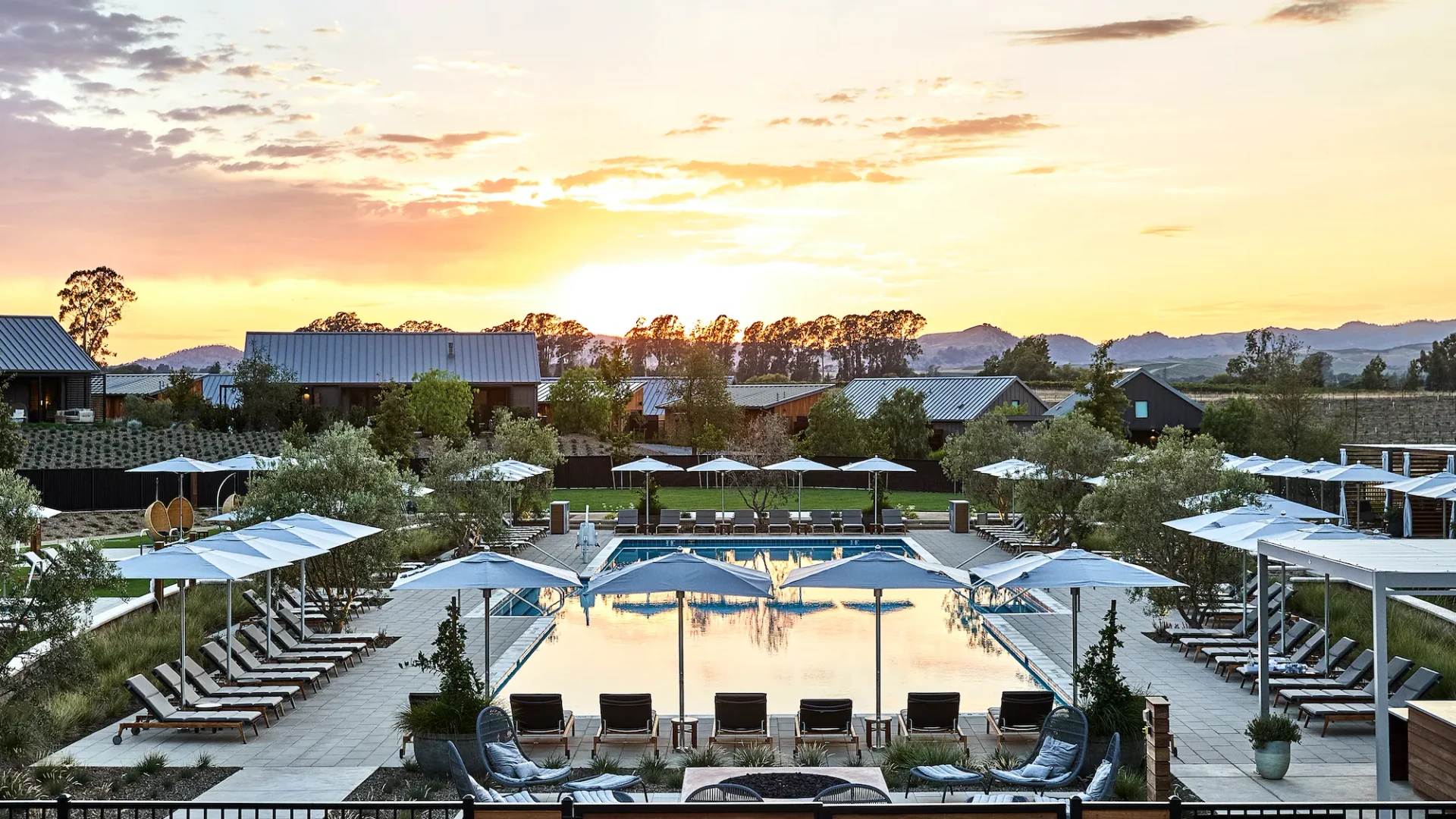
Blackstone bought Stanly Ranch at a Napa courthouse-steps foreclosure auction in March for $195 million, their second NorCal luxury hotel acquisition in seven months after the Four Seasons San Francisco purchase in late 2025 for roughly $130 million. Blackstone manages more than $325 billion in real estate assets globally across 4,530 properties, 62,150 single-family rental homes, and 274,000 housing units in the United States. For California coastal operators thinking about a 2026 or 2027 exit, the deal is worth examining not just for what it reveals about market pricing but for what it signals about who is buying and what tends to happen after the check clears.
What Blackstone Is Actually Building
Blackstone’s real estate business operates at a scale that makes individual transactions hard to contextualize without the numbers behind them. The firm controls $325 billion in real estate assets under management spanning office, industrial, hospitality, residential, and data center properties across the United States and internationally. In some residential markets, Blackstone holds between 5 and 20 percent of local rental stock, enough concentration to function as a price-setter on neighborhood-level rent comparables. The UN Special Rapporteur on adequate housing described Blackstone’s residential real estate strategy as having “devastating consequences for tenants,” citing aggressive eviction practices, processing fees, and a pattern of acquiring affordable housing through tax credit structures while delivering minimal physical improvements to residents.
The NorCal hotel acquisitions follow the same underlying playbook applied to a different asset class: identify distressed or underpriced assets with identifiable upside, reposition them under premium management, and hold for a five-to-seven year period before a refinancing or sale. Blackstone’s stated rationale for the NorCal hotel purchases is that AI-sector corporate travel will structurally underwrite luxury NorCal hospitality for at least the next decade. Scott Trebilco, Blackstone’s senior managing director for real estate, framed the Stanly Ranch acquisition publicly as a play on “rising group and leisure demand for wellness and experiential travel, alongside the continued growth in corporate travel to the region as AI adoption accelerates.” OpenAI, Anthropic, and the broader AI sector have created a genuine and growing demand for offsite and corporate retreat facilities in the Bay Area. That demand driver is real. Whether it sustains Blackstone’s underwriting assumptions across a full hold period depends on factors that are not knowable in 2026.
What Private Equity Ownership Does to a Hotel
The structural problem with PE ownership of hospitality real estate is a misalignment of financial incentives that runs through nearly every PE hotel deal regardless of the sponsor. The typical arrangement has the PE firm owning the building and the land while the brand and a third-party manager control day-to-day operations. Blackstone owns the real estate at Stanly Ranch while Auberge Resorts Collection operates the property under a management agreement, a structure that is standard across institutional hospitality ownership. In the broader market, brands like Marriott and Hilton collect royalty fees of roughly 4 to 6 percent of room revenue from properties they do not own and do not staff. The PE firm captures the asset’s operating profit but has limited direct control over the service experience that determines whether that profit grows or erodes.
That arrangement means the PE owner’s financial return has a weak structural connection to whether the property delivers an exceptional guest experience. Blackstone’s upside on Stanly Ranch comes from property value appreciation and net operating income, not from how well the front desk handles a late-night check-in. The easiest lever for improving net operating income in labor-intensive hospitality is reducing headcount. Extended-stay hotel models, which have attracted significant PE interest for exactly this reason, operate with as few as eight full-time employees where a comparable traditional hotel would require substantially more. Even within luxury hospitality, 2025 industry data documents hotels improving “efficiency” by reducing the time room attendants spend per occupied room from 25.80 minutes to 24.39 minutes, roughly a 5 percent labor reduction. Whether that produces a better result for guests or merely a faster one is a question those efficiency reports do not address.
Blackstone’s Hilton acquisition in 2007 is frequently cited as evidence that PE can improve hospitality operations. It is worth understanding what that deal actually involved. Hilton before 2007 was a fragmented, poorly managed conglomerate with no coherent brand strategy. Post-acquisition management described the company as “complacent” and lacking any culture of innovation. Blackstone cut 80 percent of corporate management, brought in a new CEO who rebuilt around unified brand standards and invested heavily in digital infrastructure, and over eleven years generated roughly $14 billion in profit from the transaction. The operational improvement was genuine. It was also made possible by starting from a company that was genuinely broken. When PE acquires a functioning, well-managed luxury property, the turnaround rationale disappears while the cost pressures remain.
The Auberge Buffer and Its Limits
Auberge Resorts Collection continuing to manage Stanly Ranch under Blackstone’s ownership is the most protective element of this particular deal from a guest experience standpoint. Auberge built its reputation on small-portfolio, high-contact luxury across properties in Napa, Carmel, Cabo, and a small number of other markets. The continuing-operator structure, where the brand that built the concept stays on under a management agreement through an ownership transition, is increasingly common in institutional hospitality buyouts. The financial logic is that the PE buyer wants the operating expertise and brand equity that comes with the existing management, not just the real estate.
That arrangement provides some insulation because Auberge’s reputational exposure is tied to the property’s performance. If Blackstone’s ownership decisions lead to degraded product quality, Auberge absorbs the review and reputation damage, which creates a genuine incentive for Auberge to defend service standards even under new ownership. The limit is that Auberge’s management contract runs for a fixed term. Blackstone’s typical hold period is five to seven years. Whether the Auberge contract extends through a full hold, what the renegotiation terms look like at renewal, and who manages the property if Auberge exits mid-hold are details absent from any public reporting on the transaction.
Sonder’s collapse in late 2025 provides a recent example of how quickly the protection of a continuing brand relationship can dissolve under financial stress. Sonder was a PE-backed hospitality company valued at $2.2 billion in 2021 that operated under a Marriott licensing agreement. When Marriott terminated the agreement over a contractual default, Sonder lost access to Marriott’s distribution channels, its equity dropped roughly 60 percent in a single session, and guests across three continents arrived at properties that were in the process of closing with minimal notice. Sonder had $621 million in revenue in 2024 but was generating $224 million in net losses against 86 percent occupancy. The Marriott brand relationship looked protective until Marriott’s interests and Sonder’s interests diverged sharply enough that the contract gave Marriott every incentive and legal ability to exit.
For Operators Sizing a 2026 or 2027 Exit
The Stanly Ranch deal confirms that sophisticated institutional capital is actively underwriting NorCal and coastal California luxury-adjacent hospitality at significant check sizes. For operators in similar categories across Newport Beach, La Jolla, Montecito, and Carmel, the institutional buyer pool is larger and more active than it was two years ago. That is meaningful context for anyone thinking about the timing of a sale.
The second thing the deal establishes is that knowing who buys you matters as much as the acquisition price. A PE acquisition at a strong multiple and an owner-operator acquisition at the same multiple are materially different transactions for what comes after. PE buyers underwrite to current cash flow and plan to optimize from there. The service standards and staffing levels that built the business’s value will be maintained to the extent they protect the asset’s net operating income during the hold period. Beyond that, they are variables.
For operators who want a clean exit at a market price with no ongoing involvement, PE buyers can be efficient and well-capitalized. For operators with attachment to what happens to the brand, the staff, and the guest experience after close, the buyer type is a factor worth weighing before accepting a letter of intent rather than after.
Sources
- Hotel Dive, “Blackstone acquires Napa Valley resort amid region’s AI boom” (March 27, 2026)
- Hotel Dive, “Blackstone acquires San Francisco Four Seasons hotel” (2025)
- The Real Deal, “Blackstone buys Napa Valley Auberge resort out of foreclosure” (March 31, 2026)
- CBS News, “UN says Blackstone is making the housing crisis worse”
- Betabrief, “Hilton Hotels Blackstone Acquisition Case Study”
- Hotel News Resource, “Efficiency Over Cuts: How Hotels Managed Labor Costs in 2025”
- Hotel Dive, “Marriott, Sonder implosion detailed in court filing”
Businesses Mentioned
Tags