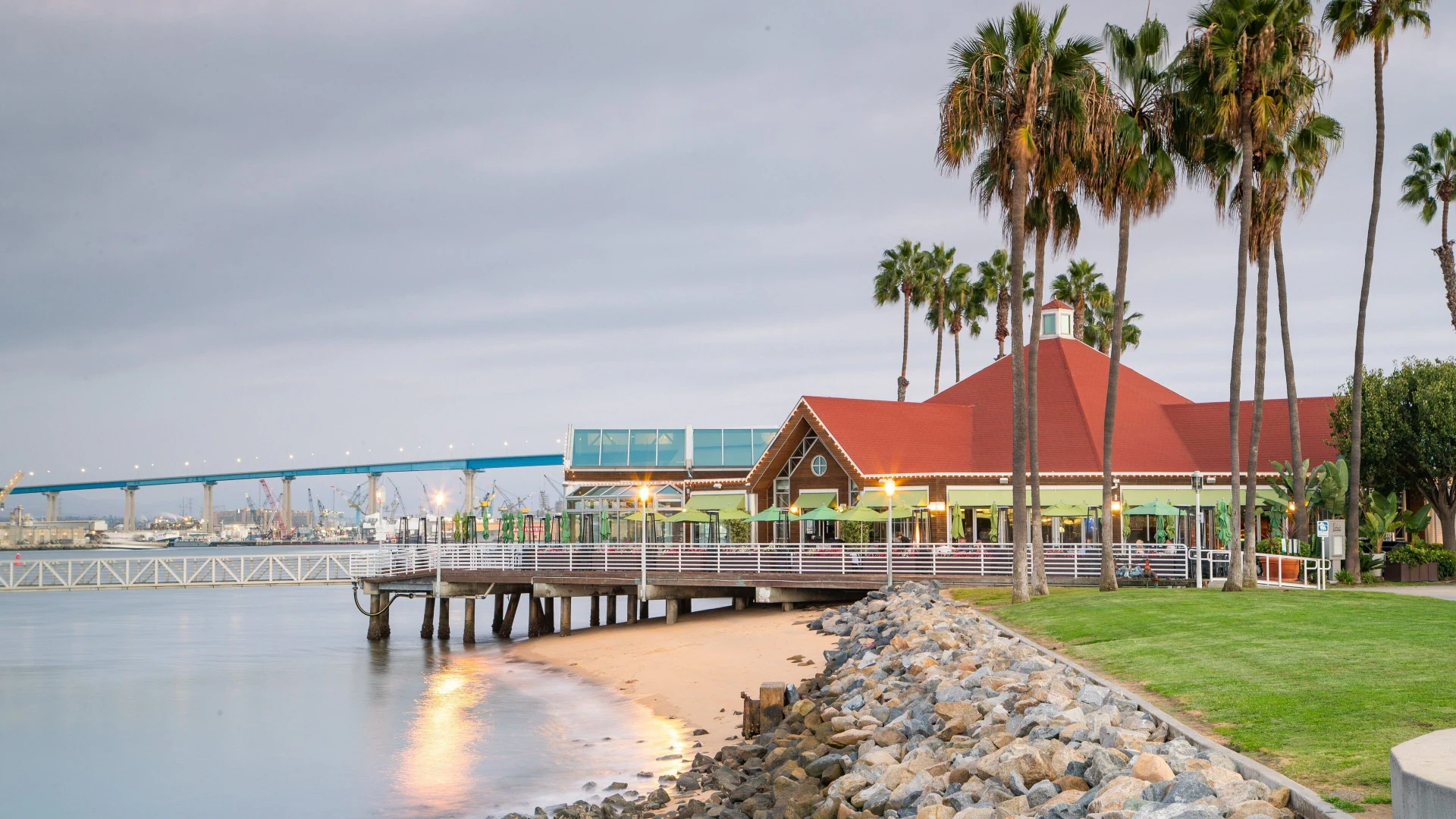
The Port of San Diego’s Board of Commissioners voted unanimously on June 23 to put a 35-year option-to-lease in front of Port Coronado Associates, the operator that has run the 13-acre Coronado Ferry Landing since 1986 and whose original 40-year master lease expires Tuesday, June 30. The new option gives PCA 12 months to satisfy eight enumerated preconditions before the 35-year term locks in. Those preconditions include financing, working drawings, equity commitments, permits, performance bonds, and a construction contract, all cleared on a stepped month-by-month timeline. Miss one and the option lapses, returning the property to the Port at no cost.
Operators looking at deals inside Port-managed centers should treat the Ferry Landing arc as the template for what these cycles cost on the subtenant side. The story worth carrying is what the 24 subtenants underneath the master lease lived through for nine months while the top of the pyramid was unresolved.
The Pyramid Freezes When the Top Layer Can’t Lock In
A Port-managed retail center sits under a different leasehold structure than a private commercial center. The master tenant, PCA in this case, holds the lease with the Port. Every restaurant, shop, and kiosk underneath holds a subtenant lease tied to that master lease. When the master lease has 30 years left, the subtenants underneath can underwrite normally. When the master lease has nine months left and no announced renewal, every subtenant lease decision freezes.
Spiro Chaconas, who has operated Spiro’s Greek Cafe at the Ferry Landing for 28 years, told reporters last fall that he had spent $500,000 remodeling his space without a long-term lease in hand. He said the company had been “bugging everybody” for years asking for an extension, and the answer was always the same. PCA could not extend any subtenant past PCA’s own lease horizon. Spiro is caught in the structural reality of a master-lease pyramid hitting expiry, and that dynamic ran through every subtenant decision at Ferry Landing for the last nine months.
Subtenant Underwriting Under the 35-Year Structure
The 35-year structure now in front of PCA carries $21.9 million in total project spend, of which $5.3 million minimum is subtenant improvements and roughly $13.9 million is landside and pier work. Construction was pulled forward a full year, from 2028 to 2027, and compressed from 36 months to 24. If the project is not finished by July 1, 2029, the rent steps up $250,000 per diem.
The minimum rent runs $600,000 in year one and reaches nearly $2 million by year 35, with four step-ups along the way. PCA paid roughly $1.09 million in fiscal year 2025 against approximately $29.4 million in center sales. The first step-up more than doubles that starting floor, and that pressure works its way down to every subtenant lease as it gets renegotiated against the new economics. For a subtenant operator now considering a buildout or a sale, the underwriting questions tighten in three places.
- A 24-month active-construction window starting in 2027 cuts straight through normal operating cycles. Model partial-year revenue impact, the cost of staying open during work, and any forced relocation.
- The $250,000 late penalty—noted in staff reports as “per diem,” though left unclarified as to whether it represents a $250,000 daily fine or an annual rate increase calculated daily—sits with PCA rather than the subtenants, and it shapes how aggressively the project gets pushed and how disruption is sequenced.
- Roughly $17.5 million in deferred maintenance was on the table, including about $12.5 million in building backlog and $5 million in waterside repairs. PCA reportedly resolved about 95 items since December. Whatever doesn’t get folded into the redevelopment scope eventually shows up as a CAM step or a pass-through.
Diligence Inside Port-Managed Centers
When we look at deals in Port-managed centers across California coastal markets, the diligence list runs longer than it would on a private-landlord deal. Four items in particular move from background detail to load-bearing on a Port-managed asset.
Master Lease Term Remaining: A subtenant lease cannot outrun the master lease above it. Seven years of subtenant term sitting under four years of master lease is a four-year cash flow, not a seven-year one.
Assignment Language and Port Approval: Public-trust land sits under different review than fee-simple commercial. Assignment to a buyer can take longer and can carry conditions the seller never had to satisfy at signing. This is where lease negotiation work earns its keep on a Port-managed deal.
Construction-Trigger Language: When the master lease lets the master tenant trigger redevelopment, the subtenants underneath inherit the disruption schedule. Read the relocation clause and the operating-during-construction language before signing.
Maintenance Allocation: Pull the deferred maintenance schedule. Anything not absorbed in the master tenant’s redevelopment scope eventually falls to the subtenants.
The Cycle Will Repeat
Coronado Ferry Landing is one of multiple California coastal sites where a first-generation Port-managed master lease is rolling through its expiry window. Operators sitting on subtenant leases inside Port-managed centers should know where their master lease is on its clock. Operators looking at buy-side deals in those centers should pull the master lease document during early diligence, because the renegotiation room around what shows up in it tightens fast once the LOI is signed. The Ferry Landing tenants who spent the last nine months waiting on a Board vote were caught at the cycle’s expiry with no extension mechanism beneath them to bridge it. The next operator going in gets a 35-year reset to underwrite against, assuming PCA clears the eight preconditions in 12 months, and that assumption is a real piece of the deal. Anyone weighing a buildout or an exit inside one of these centers should price the master-lease clock before anything else.
Sources
- Coronado Times, “Port to End Lease at Coronado Ferry Landing, Stalling $20 Million Redevelopment Project” (2025-10-30)
- The Coronado News, “Port of San Diego Ends Lease with Coronado Ferry Landing, Future Steps Unclear” (2025-11)
- Coronado Times, “Coronado Ferry Landing Could Get a 35-Year Lease, With Redevelopment Starting a Year Early” (2026-06-21)
- Coronado Times, “Port Approves Ferry Landing Lease Option, Ending Months of Uncertainty” (2026-06-24)
- Pacific Coast Commercial, “Port Agrees to Consider Revised Proposal for Coronado Ferry Landing”
Businesses Mentioned
Tags