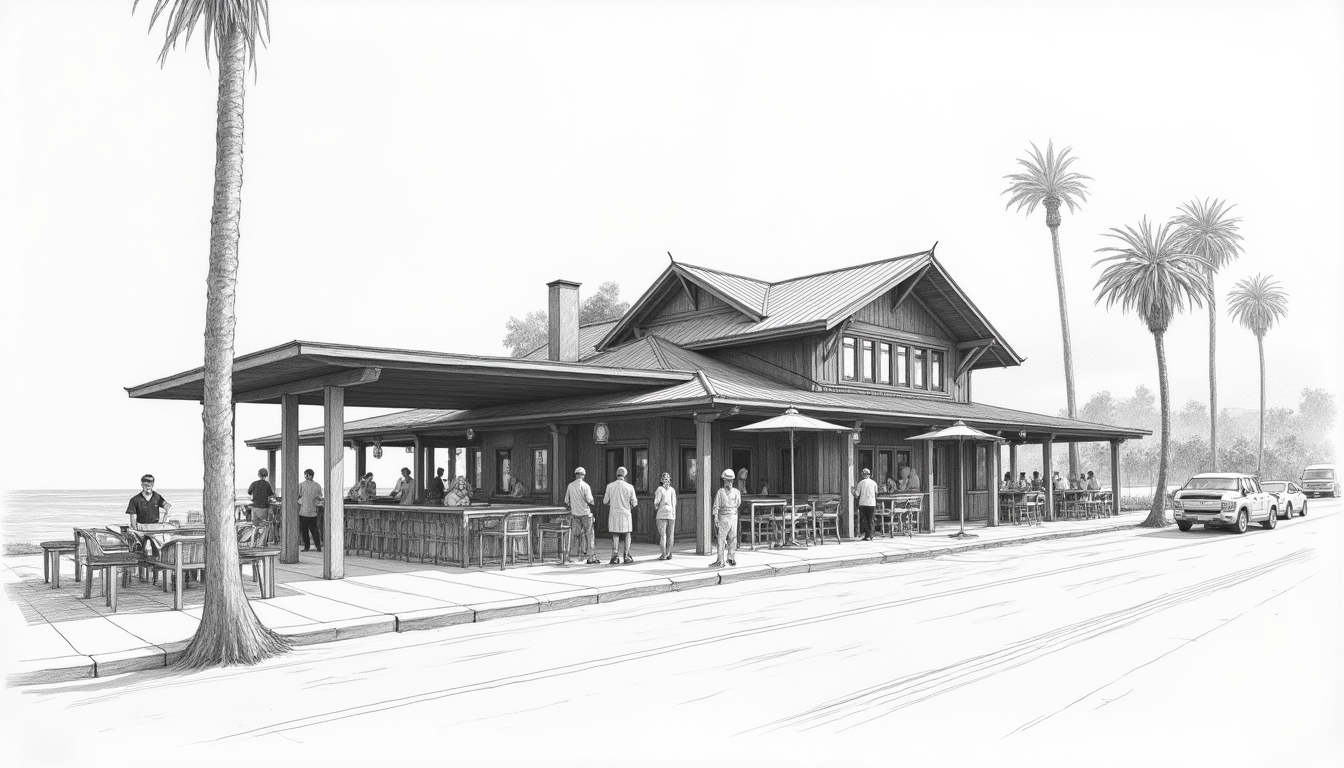
The site at 21150 Pacific Coast Highway has hosted dining since 1915, when it opened as the Las Flores Inn on what was then the Roosevelt Highway. It’s been a fish shack, a local landmark, and for the past 30 years, Duke’s Malibu. On March 13, 2026, after 14 months of recovery from fire and flood, it opened its doors again.
The Story Of How Is Worth Telling
When the Palisades Fire broke out on January 7, 2025, Duke’s parking lot became a staging area for first responders. Fire crews from LA to Ventura County used the location as a base of operations, and their presence is credited with saving the building. The structure survived with smoke damage and minor burns, but the fire itself wasn’t what shut Duke’s down.
Five weeks later, on February 13, an atmospheric river dumped heavy rain on the fire-scarred hillsides above Malibu. Las Flores Creek, which runs beside the restaurant, overflowed and within minutes, four feet of mud and debris pushed through both ends of the building and buried the parking lot. The mud caused more damage than the fire ever did.
The restaurant had to be gutted to the studs, with drywall, plumbing, electrical systems, ovens, refrigerators, furniture, and kitchen equipment all replaced from scratch. The signature koa Hawaiian hardwood paneling was salvaged and painstakingly restored, the deck was completely rebuilt, and four-foot cuts were made through every wall to prevent mold. TS Restaurants, the family-owned company behind Duke’s, estimates the closure cost roughly $10 million in lost revenue alone.
One hundred twenty-six employees were laid off, and three of them had already lost their homes in the fires.
The Long Road Back
TS Restaurants is a family company founded in 1977 by best friends Rob Thibaut and Sandy Saxten. Both founders have since passed away, but their families remain actively involved across two generations. CEO Jackie Reed, a 37-year company veteran, led the recovery. This isn’t the first time the company has rebuilt after disaster. Their original restaurant, Kimo’s in Lahaina, was destroyed in the 2023 Maui fire that killed 110 people. Nearly 300 of their 700 Maui employees lost their homes. The first Duke’s location on Kauai was destroyed by a hurricane just weeks after opening in 1989 and took three years to rebuild.
The Malibu recovery followed a deliberate sequence. The event space was finished first, and the restaurant used rented kitchen trailers to host community gatherings and celebrations of life throughout 2025. In late January 2026, a traditional Hawaiian kahu blessing was held to mark the transition from recovery to reopening. In early March, a soft opening dinner honored the first responders who had staged in the parking lot 14 months earlier.
On March 13, Duke’s reopened to the public with a scaled-back operation running Thursday through Sunday, noon to 8 PM, with 30 of the original 126 employees back on staff. The menu is limited for now, featuring the classics that define the place, including coconut shrimp, seared ahi, fish and chips, and the Hula Pie that’s been on TS menus since the first Kimo’s opened in 1977. General manager Jimmy Chavez compared the reopening to Field of Dreams, “Build it and they will come”.
The Bigger Picture Along PCH
Duke’s isn’t the only Malibu icon that made it through the recovery, and Paradise Cove Beach Cafe reopened just 32 days after the fire. Mastro’s Ocean Club returned in late May 2025 after losing its entire food and alcohol inventory to wind damage. Gladstones reopened its outdoor deck on July 4, 2025, with a new deck designed by architect Stephen Francis Jones and a 50 percent discount for locals and first responders through the month.
Not everyone was as fortunate. Moonshadows, the oceanfront restaurant that had operated for nearly 40 years, closed permanently. Reel Inn, the beloved fish shack on PCH since 1986, was initially told by the state that it couldn’t rebuild because its lease on state-owned land had been terminated. Public outcry eventually reversed that decision, but the restaurant remains closed. Cholada Thai, which had been open since 1999, faces the same uncertainty.
The fires destroyed or heavily damaged restaurants across both the Palisades and Altadena burn zones. In Altadena alone, the Eaton Fire took out nine restaurants, including Fox’s, a 69-year-old diner that had operated since 1955. Some, like Cafe de Leche, have already shared rebuilding plans, while others are still deciding whether to come back at all.
What the Recovery Revealed About Small Operators
The California Restaurant Foundation distributed $2.4 million in LA fire recovery grants, awarding $10,000 each to 253 independent restaurants and food trucks. The profile of those recipients tells a story on its own. 85 percent were single-unit operations with an average of 12 years in business, collectively employing 3,100 people. Funding came from American Express, Resy, FireAid, and Postmates.
Separately, the Foundation’s Restaurants Care program distributed nearly $1 million to 953 hospitality workers for immediate needs like housing, food, and clothing. Among those workers, 34 percent had children and 16 percent permanently lost their jobs.
These numbers paint a picture of an industry segment that runs lean and absorbs shocks with very little cushion. A $10,000 grant is meaningful to a 12-year-old independent restaurant. That tells you how thin the margins are and how much the community infrastructure depends on operators who keep showing up.
What an Operator Can Take Away
Duke’s story isn’t just a feel-good reopening, it’s a case study in what it takes to survive the worst-case scenario. TS Restaurants had three advantages that most independents don’t. A multi-location portfolio that kept cash flowing while Malibu was dark, a family ownership structure that prioritizes long-term relationships over quarterly returns, and a smooth insurance claims process, something their GM specifically called out as an exception to what many LA restaurant owners experienced.
For operators without those advantages, the takeaway is more practical. Insurance policies need to be reviewed before disaster strikes, not after. Business interruption coverage is often more limited than owners assume. Lease language matters, as the Reel Inn situation proved. And the operators who came back fastest were the ones who had relationships with contractors, a clear sense of their brand, and the resolve to rebuild rather than walk away.
TS Restaurants is already planning the next Duke’s locations, with one on Hawaii’s Big Island opening in 2026 and another on Oahu’s west side in 2028. The company’s philosophy, captured in a single line from their team, says everything about how they approach setbacks. “What started as devastation became a story of community, resilience, and aloha.”
Fourteen months after the mud buried everything, Duke’s is pouring mai tais again on PCH, and the sunsets haven’t changed a bit.
Source: Restaurant Business Online | FOX 11 LA | RestaurantNews.com | Spectrum News 1
Businesses Mentioned