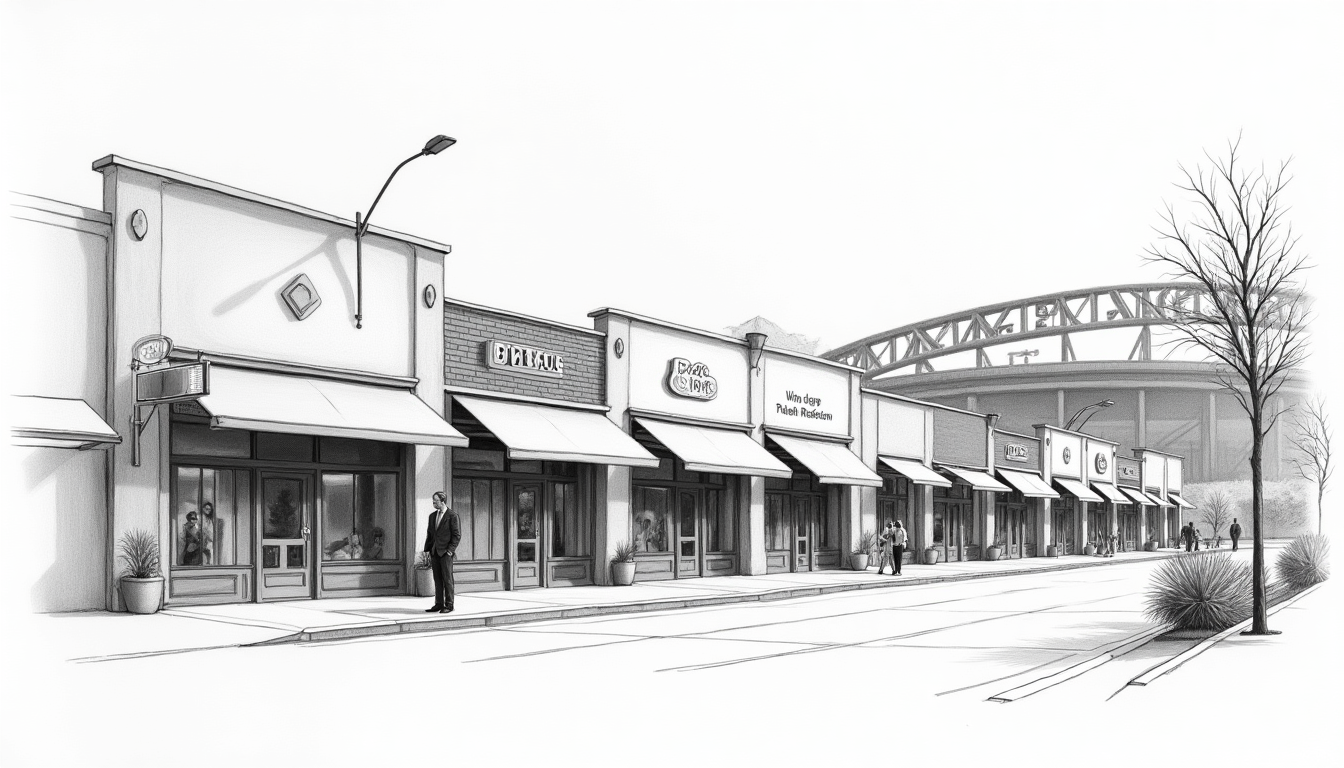
Over the past 18 months, three consecutive storefronts on Tenth Avenue in East Village have changed hands, all to the same buyer, displacing longtime operators in rapid succession. Then the same buyer picked up a building in Coronado, ending a bar that had been a community institution since 1966.
The buyer is Grupo ARHE, a conglomerate based in Mazatlan, Sinaloa, founded by Juan Jose Arellano Hernandez. The company claims over 100 businesses across hotels, gas stations, schools, construction, and food and beverage, with 2,300 employees in Mexico and around 150 in the United States. Their San Diego footprint is expanding fast, and their ambitions are bigger than what’s visible today.
The East Village Cluster
The pattern on Tenth Avenue, steps from Petco Park, played out over roughly one year.
First was 315 Tenth Avenue, the former R Place Sports Bar & Grill. Grupo ARHE acquired the property in fall 2024 at what local reports described as a heavily inflated price. It became the East Village location of Swagyu Burger Bar, a wagyu smash burger concept that Grupo ARHE took over from its original founder, Chef Steve Brown. Brown left the brand in March 2025, telling SanDiegoVille the shift toward a “franchise model, fast food going nationwide doesn’t really align with my vision.”
Next door at 317 Tenth Avenue, El Puerto Seafood By the Park closed in April 2025 after the building was acquired. Owner Alex Rodriguez told SanDiegoVille, “We don’t discuss financials, but I will say this: we never had it in mind to sell.” That space became El Prieto Taco Shop, a Sinaloa-style taqueria that also houses Mariscos Beto, a franchise seafood brand from Sinaloa. The operation employs roughly 120 people with plans to grow to 250.
The third storefront, 319 Tenth Avenue, followed the same script. Short Stop Mediterranean Cuisine was bought out and replaced by Bobby’s Pizza, which opened in September 2025.
All three addresses changed hands within a single year, each time displacing an established operator for a new Grupo ARHE concept.
The Little Club
Then came Coronado. The Little Club at 132 Orange Avenue had been a neighborhood bar since 1966. Barbara Roswell bought it after her divorce in 1972 and ran it until her death in 1999, hosting Thanksgiving dinners for Navy sailors along the way. The bar passed to her children and eventually to co-owner Tim Turner, who took a share in 2019.
The building was owned by Virginia “Ginny” Darbin, who lived to 100. After her death, the property went to her trust and was listed in February 2024. Turner tried to buy it. He was outbid by Juan Jose Arellano Hernandez, who acquired the building in May 2025. A 60-day notice came earlier this year, and March 2026 is The Little Club’s final month.
“This is my Cheers,” regular Gary Altstadt told The Coronado News. “Everybody knows everyone here.” Bartender Laurie Joyce, who worked there for 25 years, put it plainly: “We are home to the Navy, we are home to the tourists, and we are home to the locals.”
Grupo ARHE has filed an LLC called “The Little Espresso” at its Coronado office address and has announced Palmares, a Sinaloense fine dining concept, for 2026. Hernandez has described the project as “not just a restaurant, it’s the start of a restaurant project with expansion vision at national and international levels.” The company has also filed permits for a brewery concept in Eastlake.
What This Signals
I want to be clear: there’s nothing inherently wrong with outside capital entering a local market. Every market needs investment, and buyers with deep pockets can take on projects that local operators can’t afford. Grupo ARHE is creating jobs (El Prieto alone employs 120 people) and activating spaces that might otherwise sit vacant.
But the pattern is worth paying attention to if you’re a restaurant owner or a buyer in San Diego.
When well-capitalized outside investors are acquiring properties at reportedly above-market prices, it tells you two things. First, they see long-term value in San Diego restaurant real estate that local operators, squeezed by 3% to 5% margins and declining traffic, may not be positioned to capture. The distress that’s closing neighborhood institutions is creating acquisition opportunities for groups with patient capital and a different return threshold.
Second, it changes the competitive landscape. Local operators competing for the same spaces are now bidding against buyers with access to capital at a scale most independent restaurateurs can’t match. El Puerto’s owner didn’t want to sell. That didn’t matter when the building itself changed hands.
What This Means for Sellers
If you own restaurant real estate in a high-traffic corridor, particularly near Petco Park, the Gaslamp, Coronado, or other tourist-adjacent neighborhoods, your property may be worth more than you think to outside buyers with expansion strategies. The distinction between selling your business and selling your real estate is important here. An operator buying your restaurant cares about your P&L. A group assembling a corridor or launching a multi-concept brand may care more about the location itself.
For restaurant operators who lease, the lesson is different. When your landlord sells the building, your lease terms and renewal options become the most important documents you own. Operators with strong lease protections survived the East Village turnover. Those without them didn’t get a choice.
What This Means for Buyers
If you’re looking at restaurant acquisitions in San Diego, understand that the buyer pool has expanded. You may be competing with groups that aren’t evaluating deals the way a local buyer would. Their return models, timeline horizons, and risk tolerance are different.
That’s not necessarily a disadvantage. Local knowledge, operator relationships, and market-specific expertise still matter in this business. But it does mean that the best deals won’t sit on the market the way they might have two years ago. If you see a location you want, move on it. The days of taking your time in San Diego’s most desirable corridors are over.
Businesses Mentioned