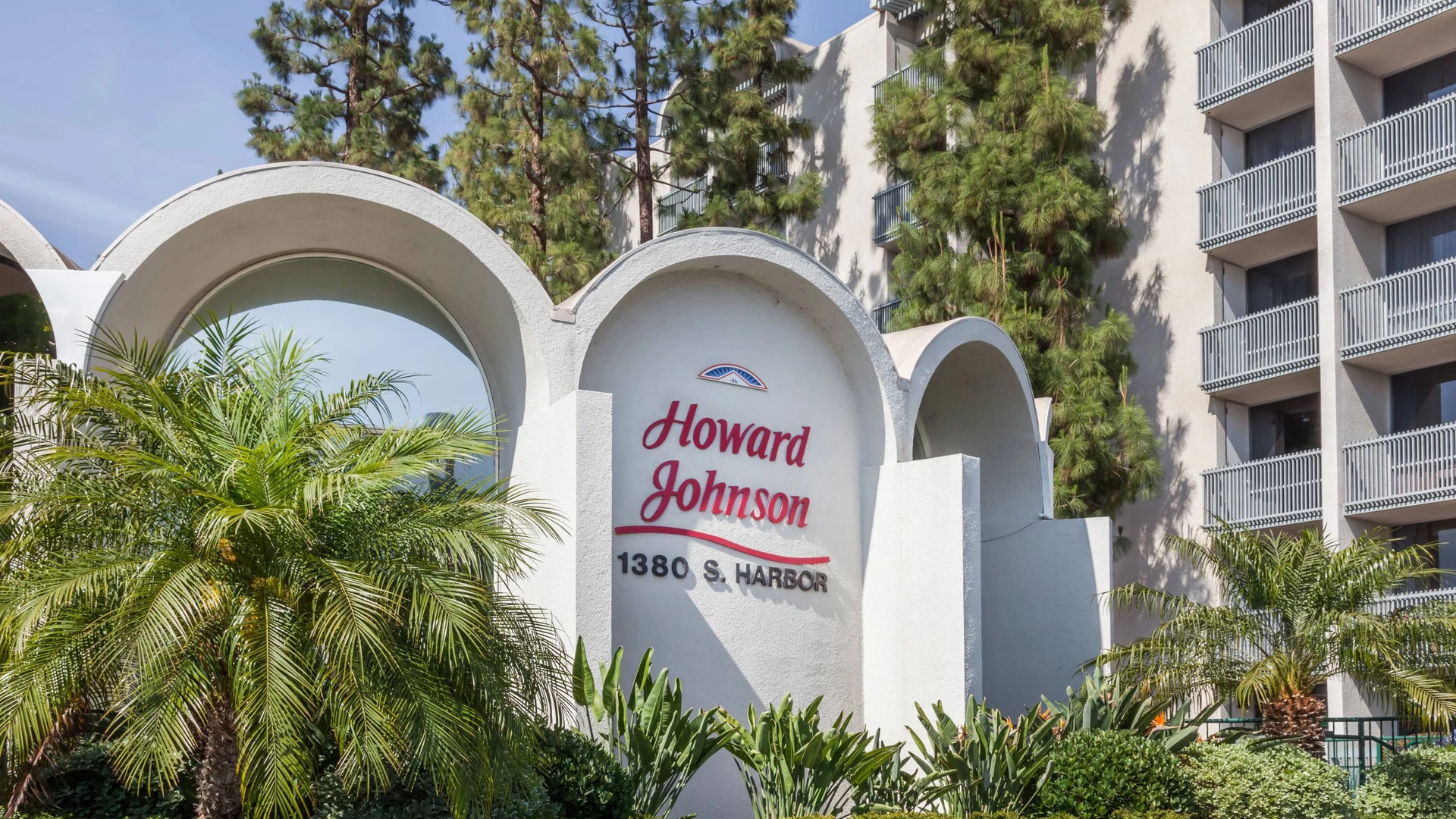
Northwest Hotel Corp. began a $30 million reinvestment on July 1 at the Howard Johnson by Wyndham Anaheim, a 60-year-old mid-century property at 1380 South Harbor Boulevard that has anchored the Disneyland resort district since architect William Pereira designed it in the 1960s. The scope covers every one of the current 302 rooms and suites, all public spaces, and the amenities, with completion targeted for June 2027. Eighteen standard rooms convert into nine larger suites, dropping the final unit count to 293. R.D. Olson Construction is running the build, and Lee & Sakahara Architects is handling the design work.
For F&B operators on Harbor Boulevard, the story matters more than it does for hotel investors. It shows what capital deployment looks like when owners of a legacy asset choose renovation over exit in a market they still believe in.
The OC Hotel Renovation Wave
The OCBJ piece places the Howard Johnson inside a broader Orange County pattern, with more than 30 hotels renovated since 2020 and 67 hotels totaling 10,649 rooms currently under construction countywide. In Anaheim specifically, the DoubleTree Suites by Hilton Anaheim Resort-Convention Center is undergoing a $15 million renovation targeted for completion in 2028. The Resort at Pelican Hill is being repositioned as a St. Regis Estate under Marriott, with completion in 2027. Disney’s Grand Californian just finished its 25th anniversary refresh, including a full reset of Napa Rose that reopened in February.
The demand data explains why the capital is deploying now. HVS reported Anaheim occupancy above 72 percent in 2025 with RevPAR above $150, and RevPAR up nearly 12 percent year-over-year into 2026, one of the strongest performances among the top 25 U.S. hotel markets. The city welcomed a record 26.5 million visitors in 2025. Anaheim booked 142 conventions, meetings, and events for 2026, projected to generate nearly 600,000 room nights. OCVIBE, the 100-acre district around Honda Center, adds a concert hall in early 2027 and two onsite hotels totaling more than 500 guestrooms, with the first expected around 2028.
When capital deploys into existing product at this scale, the message to operators in adjacent categories is simple. The demand is here, and owners are not planning exits.
The Renovation-Versus-Exit Math
Every legacy F&B operator I sit down with in Orange County eventually arrives at the same fork. The concept has run for 10, 20, sometimes 40 years. The kitchen equipment is aging and the dining room has not been touched since the last remodel, but sales are steady. The question in front of them is whether to reinvest and reset the room, or list the business and hand the reset to a buyer.
The Howard Johnson case is instructive because Northwest Hotel Corp. controls both sides of that math themselves. They own the property and manage the property. Their choice tells you what the numbers say when the same owner is looking at both options with real capital and no counterparty to sell to. Reinvestment wins when three things are true. The underlying demand in the trade area has to be durable, the property’s bones (location, structure, brand identity) still have to work at a premium price point, and the capex has to deliver a margin uplift the current format cannot reach.
For the Howard Johnson, the demand is Disneyland foot traffic plus convention overflow, both up. The bones are a walkable-to-Disneyland footprint on Harbor Boulevard with a Pereira-designed core that has aged into character rather than obsolescence. The capex is buying a room-count reduction that pushes ADR and creates suite inventory the property could not sell before.
For an F&B operator in the same corridor, the parallel test is the same three factors. They are durable demand in the trade area, a location and format that still support premium pricing after a refresh, and a capex plan that unlocks a margin the current setup cannot reach. When all three are yes, reinvestment is the play; when any one is a no, the seller’s math usually wins.
The 12-Month Adjacency Window
The Howard Johnson project runs a full 12 months, with construction phased across buildings 3 through 6 while parts of the property continue to operate. For F&B operators directly adjacent to the property on Harbor Boulevard, that is 12 months of reduced through-traffic from displaced or price-shopping hotel guests. For operators one or two blocks off, the impact softens quickly, since the resort district visitor is still there and Disneyland traffic is the anchor, not any single hotel.
The adjacency question comes up in every hotel-flanked F&B deal I look at. A reno-in-progress hotel neighbor is a temporary headwind, while a demolished-and-empty hotel parcel across the street is a longer one. The distinction matters when a seller times a listing, because going to market with an active adjacent construction disclosure is a different buyer conversation than going three quarters later when the crane is down.
The Bet on 293 Rooms
The room-count reduction from 302 to 293 with the standard-to-suite conversion is a premium-repositioning bet. The property is trading unit volume for rate. If Anaheim’s RevPAR trajectory holds through 2027, that math works. If Disney’s expansion pipeline slips or convention bookings soften, it is a longer runway to payback.
More useful for F&B operators paying attention is what happens along Harbor Boulevard in the next 12 months. Some restaurants will time exits ahead of the finished product to avoid the adjacency friction. Others will hold through the reno and market into a stronger 2028 comp environment. The pattern will tell you who is reading the same demand signal the hotels are. For any Anaheim F&B owner sitting on the fence between reinvestment and exit, the question worth asking now is which side of the Howard Johnson math your property sits on.
Sources
- Orange County Business Journal, “Millions Invested in Orange County Hotels to Renovate” (2026-06-22)
- Hospitality Net, “Anaheim’s Lodging Outlook Strengthens as Demand Drivers Expand” (2026-06-24)
- Wyndham Hotels, “Howard Johnson by Wyndham Anaheim Hotel and Water Playground”
Businesses Mentioned
Tags