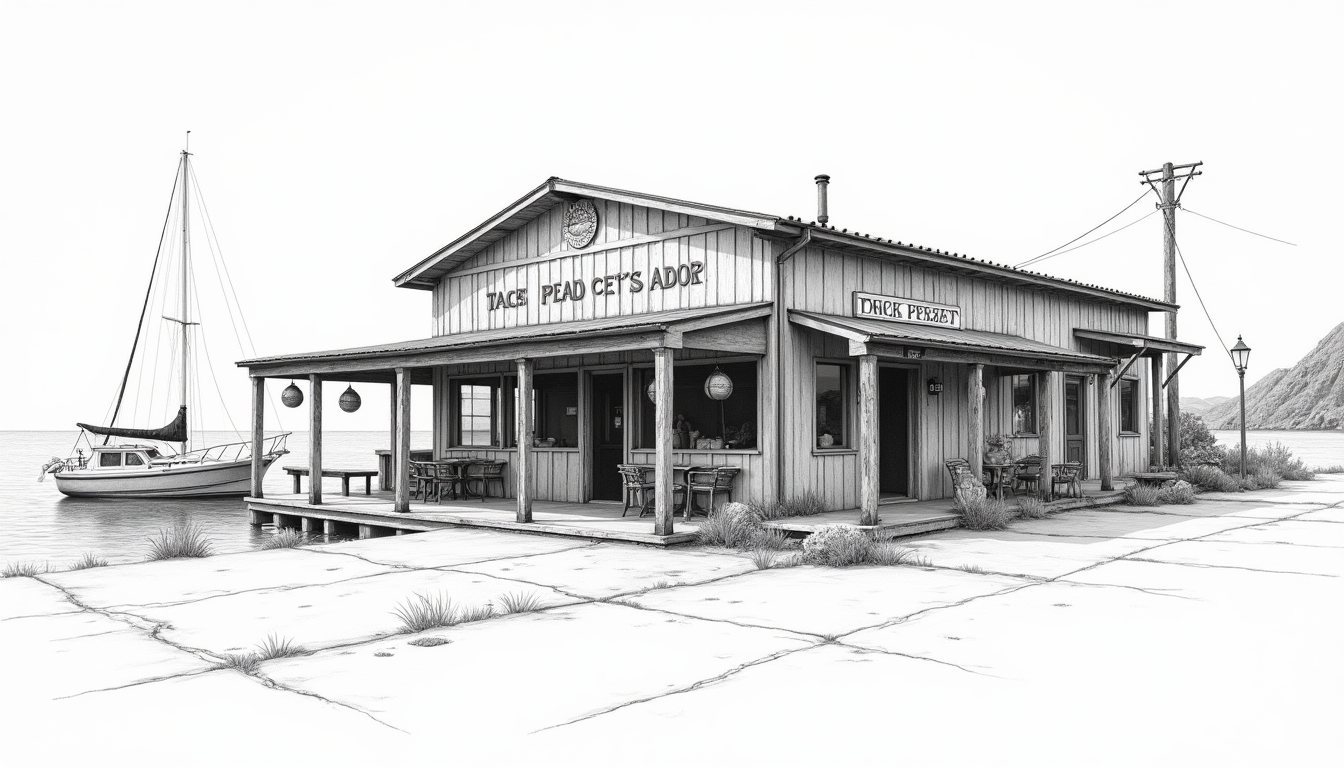
What Now OC reported this week that Jon’s Fish Market, a 46-year-old seafood market and restaurant at 34665 Golden Lantern in Dana Point Harbor, closed permanently on Sunday, May 3. Owner Shala Mansur O’Keefe, who took over from her father, founder Jon Mansur, framed it directly. “While I am devastated to be closing the doors, my health and the daily weight of small business operations have led me to what I feel is the right decision.” The two reasons in that statement, health and operational burden, are showing up together in the long-tenured California coastal closures I’m tracking right now.
What the Closure Tells You
Jon’s ran out of operating math at the exact moment a generational handover collided with a once-in-a-cycle harbor reconfiguration. Dana Point Harbor is in the middle of a $600 million redevelopment, timed to complete before the 2028 Los Angeles Olympics. The commercial core is now in active construction under Burnham-Ward Properties and Dana Point Harbor Partners, with Phase 3 focused on waterfront buildings and later phases covering wharf buildings and surface parking.
For a long-tenured tenant like Jon’s, redevelopment of this scale resets every restaurant lease, traffic pattern, parking flow, and adjacent-tenant relationship the business was built around. When the owner is also navigating a health issue and a generational handoff, the operating burden the verbatim statement names is the binding constraint.
The Cohort That’s Gone With It
Jon’s is the third long-tenured closure inside the same harbor in roughly 16 months. El Torito at Dana Point Harbor closed January 3, 2024, after 39 years, with operator Xperience Restaurant Group framing the closure as a non-renewal by the harbor’s developers. Harpoon Henry’s, a Dana Point Harbor landmark for nearly 50 years, was set to close January 28, 2025 as part of the same harbor redevelopment cycle. That’s roughly 50 years, 39 years, and 46 years of tenure, all at the same harbor, all closing inside one redevelopment cycle. All three were concepts whose lease, location, and operating relationships could not be transplanted into a redeveloping property under current cost conditions.
The Wider Coastal Pattern
Pull back a level and the same cycle is running across SoCal coastal independents that aren’t tied to a single redevelopment. Spaghetti Bender in Newport Beach closed March 2, 2025 after 55 years under owner Michael Hoskinson. Las Cuatro Milpas in San Diego’s Barrio Logan, founded in 1933, closed on Christmas Eve 2025 after 92 years; the building sold to a neighboring property owner for $2.2 million.
The cost stack underneath these closures is the same one Technomic flagged when the 2.3% national independent decline came out earlier this year, with operator input lines (labor, rent, insurance) running mid- to high-single-digit increases. California adds its own accelerants on top of those national cost lines. The state minimum wage moved to $16.90 an hour on January 1, 2026. Los Angeles hotel workers at properties with 60 or more guest rooms reach $25 plus an $8.15 hourly health benefit on July 1, 2026, with scheduled increases to $27.50 in 2027 and $30 in 2028 timed to the FIFA World Cup and the 2028 Olympic Games. Property revaluations on commercial centers that turned over in the 2021-2022 cycle are still flowing through to operators on triple-net leases.
What This Means for California Coastal Operators
The closure ledger across coastal California now reads in cost-cycle increments of 39 years, 46 years, roughly 50 years, 55 years, and 92 years, all winding down inside the same period. All of them ran out of operating math at the moment a generational handoff, a redevelopment cycle, or a health event coincided with a cost stack the original lease was never priced for.
For owner-operators carrying 20-plus years on a coastal lease, two implications follow. First, generational handoff and operator health show up as proximate triggers more often now. The cost stack does not cause those events, but it sets a margin floor at which the second-generation owner inherits a business that no longer carries the operating burden through a setback.
Second, the multi-decade independent that’s still profitable is the most acquisition-friendly asset in this cycle. Strategic buyers, family offices, and PE-backed roll-ups are looking for operating histories with margin durability, not turnaround stories. The window to sell a restaurant on trailing performance, before cost compression compounds into the EBITDA line or before a redevelopment cycle resets the lease, is the part of the cycle that closes quietly.
If you’ve been operating at the 20-plus-year mark in any California coastal market, and the cost stack is starting to feel unfamiliar, or your harbor or center is beginning a redevelopment cycle, the strongest structured exit is the one set up before the lease, the property tax bill, the wage line, or a health event forces a reactive timeline. If this sounds like your situation, let’s have a confidential conversation.
Sources
- What Now OC, “A 46-Year-Old Seafood Market Has Closed in Dana Point Harbor”
- California Construction News, “Construction Begins on Dana Point Harbor Commercial Core, a $600M Redevelopment” (March 23, 2026)
- NBC Los Angeles, “Harpoon Henry’s Dana Point and Rose Venice Close”
- Picket Fence Media, “Dana Point Harbor’s El Torito Shutters Doors After 39 Years”
- Newport Beach Patch, “Beloved Restaurant to Close in Newport Beach After 55 Years”
- CBS 8 San Diego, “Las Cuatro Milpas to close after 92 years as Barrio Logan building sells for $2.2M”
- Nation’s Restaurant News, “America Is Losing Independent Restaurants”
- Davis Wright Tremaine, “California Statewide and Local Wage Increases” (December 2025)
- Hotel Dive, “LA Passed a $30 Minimum Wage for Hospitality Workers”
Businesses Mentioned
Tags