When a James Beard Award-winning chef picks your corridor for his next restaurant, it tells you something about the economics of that corridor.
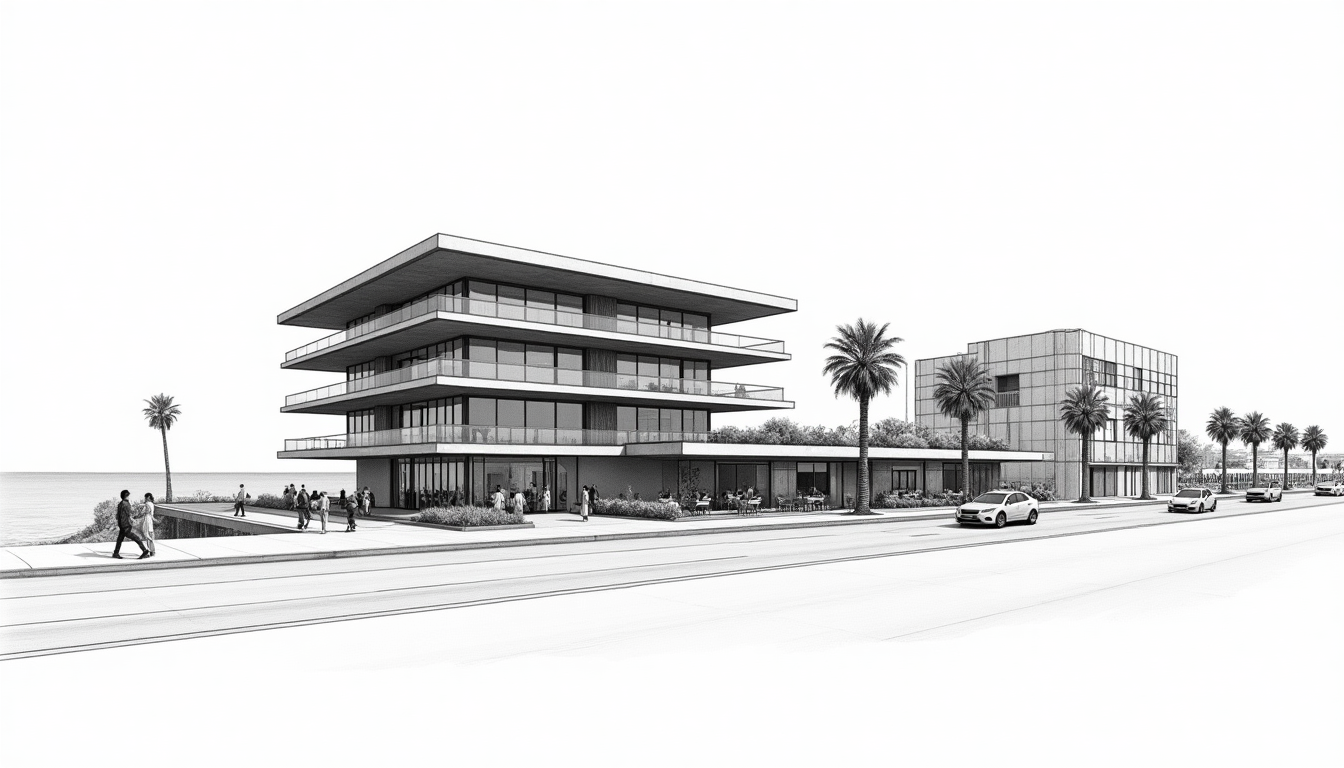
Tyson Cole is opening Uchi’s eighth location at 2510 West Coast Highway on Mariners’ Mile in Newport Beach. It’s the brand’s first Orange County restaurant. The space sits inside a new mixed-use building with 36 residential units directly above the restaurant. Steps from Newport Bay, surrounded by a neighborhood where every residential zip code ranks among the 100 most expensive in the country.
This isn’t a speculative play on an emerging market. It’s a calculated bet on a corridor where the demand side of the equation has already been engineered.
The Mixed-Use Model: Captive Demand by Design
Newport Beach is executing a three-zone development strategy in 2026: Newport Center (the Fashion Island hub), Uptown Newport (1,244 new residential units with 11,500 square feet of ground-floor retail), and the Mariners’ Mile corridor running along West Coast Highway.
The pattern is the same across all three zones: put residents on top, put restaurants on the bottom. Create captive dining demand that doesn’t depend on drive-by traffic or weekend tourism.
The Uchi building is the clearest expression of this model. Thirty-six households living above a high-end Japanese restaurant with an established national reputation. Those residents don’t need to be marketed to. They need an elevator.
This is different from the traditional restaurant real estate model where operators compete for foot traffic in retail strips and shopping centers. Mixed-use captive demand fundamentally changes the calculus on things like lunch revenue, weeknight covers, and off-season performance. The customers live in the building.
What $58 Per Square Foot Actually Means
Newport Beach average retail rents sit around $58 per square foot. Restaurant-specific spaces are listed at “price upon request,” which in broker language means higher.
At $58/sqft, a 3,000-square-foot restaurant is paying $174,000 a year in base rent before triple-net charges. That’s $14,500 per month in rent alone. To keep your occupancy ratio healthy at 8-10% of revenue, you need to be generating $1.7 to $2.2 million in annual sales out of that space.
That’s the filter. These rents don’t just price out weak concepts. They select for operators who can consistently hit high ticket averages with low vacancy rates. Uchi, which commands $80-120 per person across its existing locations, fits the math. A family Italian joint trying to do $25 covers would not.
This explains why the development pipeline along Mariners’ Mile is attracting national and regional brands with proven unit economics. Mastro’s at 8112 East Coast Highway is undergoing a full interior renovation and patio enclosure. Arc Balboa Island, from Noah and Marin von Blom (the operators behind Arc Butcher & Baker and Arc Food & Libations in Costa Mesa), is building a new full-service restaurant at 224 Marine Avenue with a two-story garden structure targeting late 2026. Woody’s Diner, the retro breakfast concept, is eyeing a Newport Beach location.
These aren’t startups testing the market. These are operators who’ve done the rent math, stress-tested the revenue model, and decided the numbers work.
The Corridor Effect on Existing Operators
Here’s the part that matters to current restaurant owners in Newport Beach: when a corridor gets developed with this kind of intention, it lifts comparable values across the area.
New mixed-use construction along Mariners’ Mile creates a halo effect. Foot traffic increases. The dining corridor becomes a destination rather than a collection of individual restaurants. Residential density rises, which means the customer base for every restaurant in the area grows structurally, not just seasonally.
If you own a restaurant between PCH and Newport Bay and you’ve been running consistent numbers, your business just got more valuable. Not because you changed anything, but because the neighborhood around you is being engineered to drive more customers to your door.
This is the same dynamic we saw play out in Little Italy in San Diego over the past decade and along the South Coast Plaza corridor in central OC. When municipalities and developers invest in mixed-use density around restaurant districts, the operators who are already there with good leases and clean financials are sitting on appreciating assets.
The Buyer’s Calculus
For buyers looking at Newport Beach: the entry point is high. There’s no getting around $58/sqft rents and the premium that comes with one of the most affluent zip codes in the state. But the development pipeline is creating something that’s hard to find elsewhere: structural demand growth.
Most restaurant acquisitions come down to a bet on whether current revenue is sustainable. In a market where the city is actively building residential density around dining corridors, the sustainability question has a different answer than it does in a suburban strip center.
The tradeoff is that the capital requirements are significant. SDE multiples for well-positioned Newport Beach restaurants tend to run at the higher end of the range because buyers are paying for location premium and demand visibility that’s baked into the real estate plan.
The Bigger Picture
Newport Beach’s development strategy is a preview of where restaurant real estate is headed across coastal Southern California. The standalone restaurant pad is becoming less common. Mixed-use is the default. And the operators who understand how to perform in that environment, high volume, high ticket, consistent execution, are the ones securing the best positions.
Uchi isn’t opening on Mariners’ Mile because the sushi is good. It’s opening because the economics of captive-demand mixed-use development make a restaurant at that address a high-probability bet. The development creates the customers. The brand captures them.
For OC restaurant owners thinking about timing: the market is telling you something. National brands are committing capital. Development timelines are locked in through 2027. Rents are climbing. If your business is performing, the valuation conversation is more favorable now than it will be after another year of construction brings more competition to the table.
Businesses Mentioned