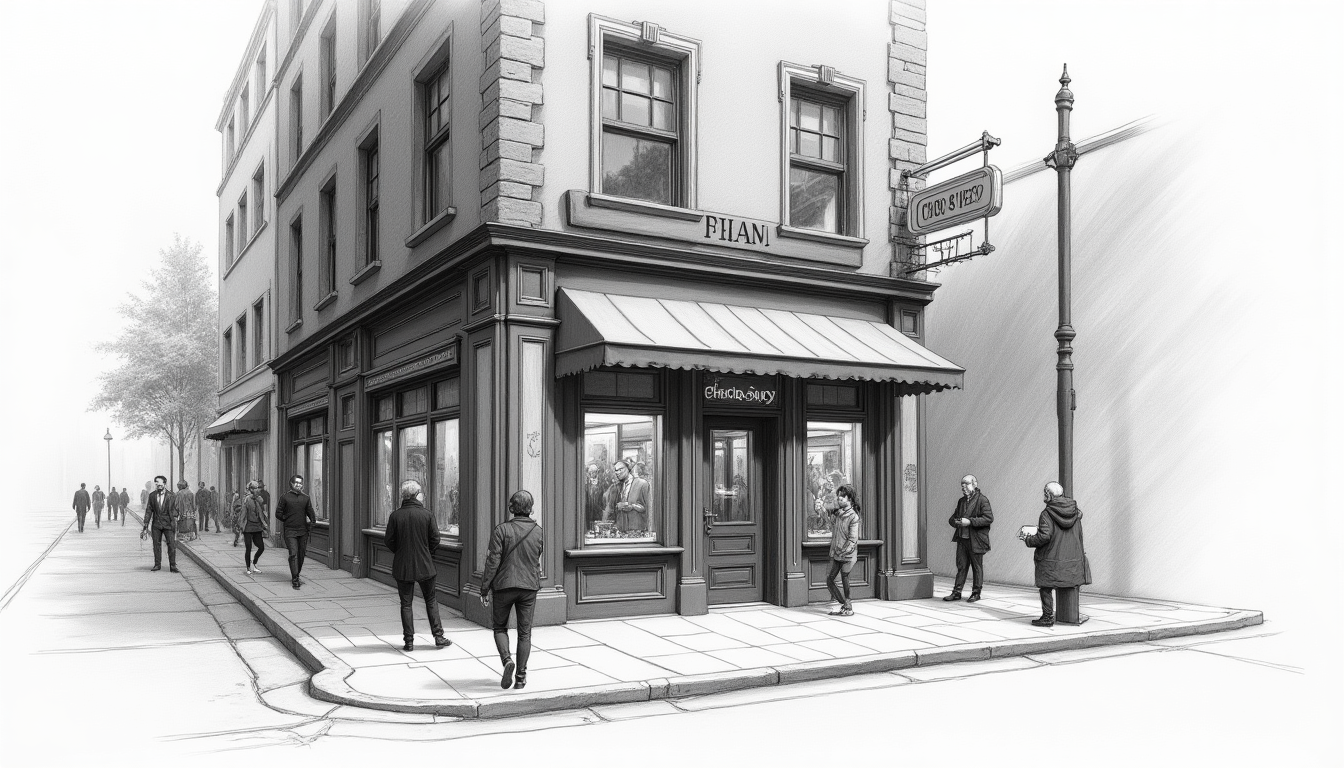
The building at 2877 University Avenue in North Park has been dark since 2019, when Pekin Cafe closed after operating continuously since 1931. Founded by Chinese immigrant Leo Fong, the restaurant ran for nearly 90 years under three generations of family ownership before the doors finally shut. For the past seven years, the historically designated building has sat vacant on one of San Diego’s most active restaurant corridors while the neighborhood around it transformed.
That seven-year vacancy is about to end with a project that signals continued investor confidence in the corridor. Jacquelyn Kelly and Jason Bess are putting approximately $2 million into converting the space into a dual-concept venue opening in late 2026. The project preserves the historic exterior while completely redesigning the interior to house two distinct operations under one roof.
Two Concepts, One Space
The first concept, Chop Suey Lounge, is a cocktail-focused space drawing from mid-century lounge culture. The programming includes craft cocktails, premium spirits, elevated Chinese-American bar fare, live jazz, DJ sets, and rotating entertainment. The name deliberately references the building’s original Chop Suey signage, connecting the new operation to the space’s nearly century-old identity.
The second concept, Ginger Roots, is a reservation-only fine dining experience built around an eight-seat chef’s table and private dining room. The menu focuses on Asian-fusion cuisine through curated tasting menus. It is an intimate format designed to operate at high per-cover revenue with minimal seating capacity.
Kelly brings hospitality leadership experience from San Diego’s Consortium Holdings, one of the city’s most successful bar and restaurant groups. Bess brings infrastructure and development expertise. The pairing of an operator with deep local hospitality knowledge and a developer with buildout experience is the kind of partnership structure that tends to produce well-executed projects because neither skill set is trying to compensate for the other.
Why the Dual-Concept Model Makes Financial Sense
Running two distinct concepts in a single lease footprint is a strategy that has gained traction across the restaurant industry because it addresses the fundamental economics of high-rent corridors. A single-concept restaurant on University Avenue in North Park is competing for every dollar of revenue against lease rates that have climbed steadily as the neighborhood has gentrified. Adding a second revenue stream within the same four walls spreads fixed costs across a larger top line.
The specific pairing here is smart. A cocktail lounge generates its highest revenue in the evening and late-night hours, with beverage margins significantly higher than food margins. A fine dining tasting menu operation with limited seating runs at premium price points with controlled labor costs. The two concepts share back-of-house infrastructure, utilities, insurance, and property taxes while operating at complementary dayparts and margin profiles.
Compare that to a single-concept casual dining restaurant occupying the same square footage. The casual operator is fighting for lunch and dinner covers at moderate check averages, competing directly with dozens of similar concepts within a one-mile radius on University and 30th, and absorbing the full lease and overhead burden on a single revenue stream. The dual-concept model does not eliminate those pressures, but it does create more paths to breakeven.
What the Investment Tells You About North Park
Committing $2 million to a restaurant buildout in a neighborhood where 72% of operators reported declining traffic and profit margins have compressed to 3-5% requires a specific kind of confidence. It is not confidence that the broad market is healthy, because the data clearly says otherwise. It is confidence that the specific location, the specific concept, and the specific execution will outperform the average.
North Park has consistently been one of San Diego’s most resilient restaurant corridors because it benefits from dense residential foot traffic, a young demographic that prioritizes dining and nightlife spending, and a built-in neighborhood identity that draws visitors from across the city. University Avenue and 30th Street function as destination corridors in a way that most suburban restaurant locations do not, and that destination traffic supports higher rents and more ambitious concepts.
The vacancy pattern on the corridor also tells a story. When restaurants close in North Park, the spaces do not sit empty for long. New concepts move in, often with significant buildout investment, because operators and investors see the corridor as one of the few places in San Diego where a well-executed concept has a genuine path to profitability despite the cost environment. A heritage space with nearly a century of name recognition adds an intangible layer of built-in community goodwill that no new construction can replicate.
What Buyers and Sellers Should Take From This
For buyers considering restaurant acquisitions in San Diego, the dual-concept model is worth studying as a framework for maximizing revenue per square foot in high-rent locations. The structure works best when the two concepts operate at different dayparts, target complementary customer profiles, and share as much back-of-house infrastructure as possible. It does not work when two concepts compete for the same customer at the same time of day, which splits traffic instead of expanding it.
For sellers, particularly those operating single-concept restaurants in premium corridors, the investment signals that well-capitalized buyers are still willing to pay for the right commercial real estate in the right neighborhoods. If your lease terms are favorable, your space is flexible enough to support format changes, and your location has the foot traffic to sustain an ambitious concept, those factors carry real value even if your current operation’s margins are compressed.
The Chop Suey Lounge and Ginger Roots project is a single data point, not a market trend. But it is a $2 million data point in a neighborhood that skeptics have been calling overbuilt for years, from operators who understand the San Diego hospitality market well enough to bet their own capital on it. That kind of conviction, backed by real money rather than speculation, is worth paying attention to.
Businesses Mentioned
Tags