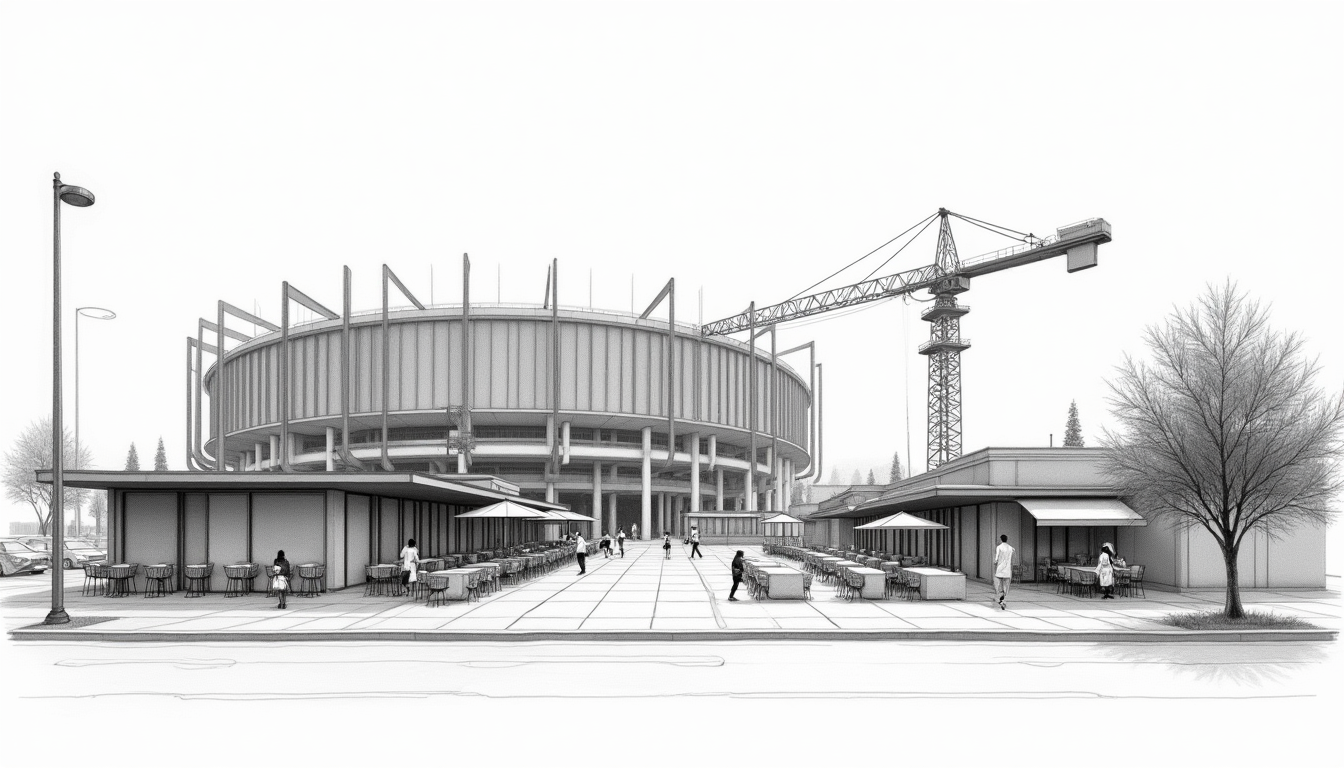
Orange County is about to get a new downtown. And if you operate a restaurant anywhere near Anaheim’s Platinum Triangle, the competitive landscape is about to change permanently.
OCVibe—the $4-5 billion mixed-use entertainment district being built around Honda Center—will deliver 35+ restaurants and bars across 95 acres when fully built out. Phase 1 restaurant openings begin this year. A 50,000-square-foot food hall follows in early 2027. Two hotels, 2,000+ apartments, a 5,700-seat concert hall, and 168,000 square feet of office space complete the picture.
This isn’t a strip mall with a few restaurant pads. It’s a purpose-built dining ecosystem designed to capture every meal occasion: pre-game, post-concert, weekday lunch, weekend brunch, date night, tourist dinner, within a single campus. And it’s backed by $1 billion already spent on Phase 1 and a $1.1 billion privately funded renovation of Honda Center itself.
What’s Coming and When
The restaurant rollout follows a phased timeline tied to the broader construction:
2026: A Restaurant (River Jetty Restaurant Group) anchors the Honda Center entrance, plus three additional full-service restaurants along Restaurant Row. Tim Gresham, who’s curating the tenant mix, is specifically recruiting restaurant groups from Texas, Chicago, and New York, operators with “staying power and patience” who can commit to 10+ year runs. Five chef teams have committed, though names remain under wraps.
Early 2027: Katella Commons opens, a 50,000-square-foot market hall featuring 21 chef-driven kitchens curated by Chef Remi Lauvand (formerly of Montrachet in New York). Named tenants include Chef Debbie Lee with two Korean-American concepts: Pado (raw and seafood bar) and Mokja (a casual Korean bodega). Six uniquely themed bars and lounges round out the hall, from a moody wine cave to a Joshua Tree-inspired beer garden to a barrel-shaped European cafe.
2027-2028: The Golden Bear music venue (350-500 capacity), additional retail, a South Plaza, and the first hotel. Substantial completion is targeted before the 2028 LA Olympics, when Honda Center hosts indoor volleyball.
2029-2032: A second hotel, 1,960-2,250 apartments (including 292-340 affordable units), and full buildout of the northern plaza.
The Captive Audience Math
What makes OCVibe different from a conventional restaurant cluster is the built-in demand stack:
- Honda Center: 18,336-seat arena hosting Ducks games, concerts, and events year-round
- New concert hall: 5,700-capacity venue designed by Populous (104,000 SF)
- The Weave: 168,000 SF mass timber office building, OC’s first, with ground-floor retail. Weekday lunch crowd, guaranteed.
- Residential: 2,000+ apartments bringing a permanent on-site population
- Hotels: 550 rooms across two properties, channeling tourist and business traveler spend
- 2028 Olympics: Indoor volleyball at Honda Center, a global audience visiting the campus
Add it up and you have a dining market that doesn’t depend on marketing, SEO, or Yelp reviews. The foot traffic is structural. The question for restaurant operators inside OCVibe isn’t “can I get customers?”; it’s “can I handle the volume?”
What This Means for Operators Outside OCVibe
The competitive implications for restaurants in the surrounding Platinum Triangle and greater Anaheim market are significant.
Traffic diversion: Restaurants on Katella Avenue and in the Anaheim GardenWalk that currently capture pre-game and post-event dining spend will see that traffic redirected into OCVibe’s closed ecosystem. The development is specifically designed to keep visitors on campus from arrival to departure. Every dollar spent at Katella Commons or Restaurant Row is a dollar that doesn’t flow to the steakhouse across the street.
Talent drain: With 35+ restaurants needing to staff up simultaneously, OCVibe will intensify an already brutal labor market. OC’s restaurant workforce is finite. Campus operators with institutional backing can offer competitive wages and benefits packages that independent restaurants struggle to match.
Rent contagion: As OCVibe establishes premium lease rates, likely well above the OC average of $33.73/SF, surrounding landlords will benchmark higher. Marginal operators already squeezed by OC’s 3.2% retail vacancy rate (one of the tightest in SoCal) will face lease renewals priced against a new reality.
Capital competition: Local operators looking to renovate, expand, or remodel will compete for contractor capacity with a $4-5 billion project. Construction costs and timelines will be affected across the market.
The Valuation Implications
OCVibe creates a two-tier market for restaurant valuations in the Anaheim area:
Inside the campus: Trophy locations with guaranteed traffic will command premium valuations. These are institutional-grade restaurant assets, the kind private equity groups and multi-unit operators target. SDE multiples for successful concepts inside OCVibe will likely exceed 3x, supported by revenue visibility that street-level restaurants can’t match.
Outside but nearby (short-term, 2026-2028): Construction disruption, traffic pattern shifts, and competitive uncertainty will soften valuations for existing operators within a one-to-two-mile radius. Buyers will discount for the OCVibe risk, and sellers who planned to exit in this window may face lower offers.
Outside but nearby (medium-term, 2028+): If OCVibe succeeds as a 365-day destination, the halo effect could lift the entire Platinum Triangle. Higher residential density, more foot traffic, and the “new downtown” branding may raise all boats, but only for operators who survive the transition period. The restaurants that close between now and 2028 won’t benefit from the rising tide.
What OCVibe Gets Right, and the Risk It Carries
The tenant curation strategy is notable. Rather than leasing to the highest bidder, OCVibe is hand-selecting operators with institutional depth and proven track records. The requirement for “10 years of staying power” filters out concepts that burn bright and flame out. Chef Remi Lauvand curating a 21-stall food hall, rather than just filling spaces, suggests a quality-first approach that could set a new standard for SoCal food halls.
The risk? Scale itself. Thirty-five restaurants in a single campus is a bet that the market can absorb that much supply simultaneously. If the concert hall underperforms, if the residential towers take longer to lease, or if a recession hits during the 2027-2028 ramp-up, even well-curated concepts will struggle with below-projection traffic.
For context: OC’s restaurant opening pipeline is already cooling, down from roughly 100 new openings in 2025 to a projected 50 in 2026. OCVibe is adding enormous supply into a market that’s already showing caution.
The Bottom Line
OCVibe is the most significant development to hit Orange County’s restaurant market in a generation. It will create winners: the operators selected for campus locations, the surrounding businesses that ride the halo effect, the landlords who benefit from rising benchmarks. And it will create losers: the Katella Avenue restaurants that lose event-night traffic, the independents that can’t compete for staff, the operators whose lease renewals now reflect OCVibe pricing.
If you own or operate a restaurant in the Platinum Triangle or greater Anaheim area, the next three years will reshape your competitive position one way or another. Now is the time to understand where you stand.
Evaluating how OCVibe affects your restaurant’s value or exit timeline? Contact Smith Allen Group for a confidential assessment of your position in this evolving market.
Businesses Mentioned
Tags