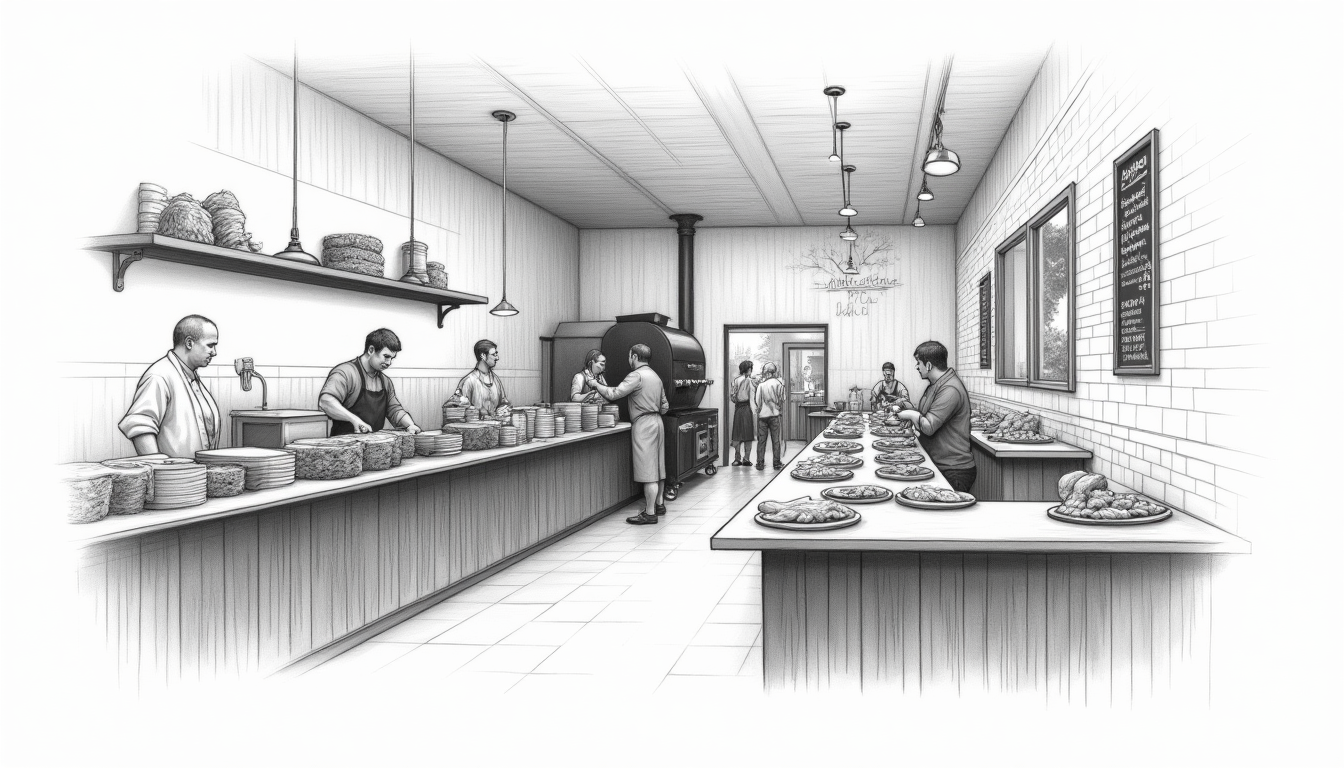
Rashad Armstead, the Chopped winner who has been operating in the East Bay since 2015, soft-opened Saints Smokehouse at 218 13th Street in downtown Oakland as a weekend pop-up in November 2025, on a project that has been in the works for four and a half years. The room runs Wednesday through Friday from noon to 5 p.m. and Saturday from 2 to 6 p.m. Armstead is running it largely solo with his mother Cecilia Armstead and three staff members, self-financing the build, handling inventory and prep himself, and cooking on two custom Southern Pride smokers.
A Chopped winner opening his third Bay Area room is a regional opening on its face. The operating shape Armstead is opening with is the read for California coastal independents this cycle.
What the build-out is saying
When a credentialed operator on his third concept signs a downtown Oakland room and builds it for four and a half years on a self-financed track, the move is making a specific bet on operator economics. Armstead started as a vendor at the Ashby Flea Market in Berkeley in 2015, opened Crave BBQ in Richmond’s Hilltop Mall, and ran Grammie’s Down-Home Chicken & Seafood in Oakland before competing on Chopped and winning his episode in 2019. Saints is the third concept, and the build is structured around keeping costs down, with plates priced at $18 for pork ribs and a side, $25 for half a smoked chicken, and $1 wings on Wednesdays. The room soft-opened in November to weekend traffic and is currently selling out before 3 p.m.
Armstead told Berkeleyside he refused the pay-for-play influencer route when advisers suggested it, saying “I’m not concerned about the grandiose or going viral. I just want to bring good food to Oakland.” The growth path has been word-of-mouth through friends and co-workers, with a Visit Oakland Instagram clip in late April lengthening the lines.
That set of facts is the survival shape of the credentialed independent in 2026 California coastal F&B. Slow-build, self-financed, owner-on-the-line, cost-controlled, customer acquisition through word-of-mouth instead of paid play. Every input on that list is the inverse of the cost stack that is closing rooms across the rest of the country.
The cycle Saints is opening into
The reason the build-out shape matters is the cycle the room is opening into. The number of independent restaurants in the United States declined 2.3% in 2025, a net loss of about 9,500 locations, bringing the total to 412,498. Full-service independents took the hardest hit, posting a 2.6% decline and a net loss of about 6,400 rooms. The Top 500 restaurant chains grew unit count 1.5%, added about 3,600 units, and now make up about 35% of the industry footprint. Technomic’s David Henkes told Restaurant Business Online that “it’s harder than ever, for the industry in general, but for independents in particular to operate.”
The National Restaurant Association’s 2026 State of the Industry release reported that 42% of operators said their restaurant was not profitable last year, 60% reported softer customer traffic, and more than nine in ten flagged food, labor, insurance, energy, and swipe fees as significant challenges. Margins and profitability have gone down significantly while input costs, per Henkes, have moved up mid-to-high single-digits across labor, rent, and insurance.
A four-and-a-half-year self-financed build is the shape of an independent operator structuring out of that stack the only way the math works. The build runs without outside capital pulling rent and revenue covenants, without paid acquisition spend distorting the daypart shape, and without a half-staffed kitchen inflating food cost. The owner is on the line for inventory, prep, supply runs, and the smokers, and the daypart is sized to what the kitchen can actually clear.
The California Coastal Read
The Bay Area independent on a slow-build owner-operator track is the survival profile in 2026 California coastal F&B, and the same read applies down the corridor through Monterey, Santa Cruz, the Central Coast, Los Angeles coastal, and San Diego. The closures hitting hardest right now are full-service independents that signed against 2018 unit economics and cannot absorb the 2026 cost stack. The operator who built the room around the owner’s own labor, on a self-financed runway, with a clean P&L, is the one still standing.
The strategic value of that profile is highest right now to the multi-room operator who can amortize back-office, beverage program, and labor compliance across multiple rooms. A credentialed independent with two prior concepts behind them, a clean self-financed P&L, and a structured slow-build is exactly the acquisition shape platforms are looking for when they go to buy a restaurant in this market. If this sounds like your situation, let’s have a confidential conversation.
Sources
- Berkeleyside, “Saints Smokehouse smokes its way into Oakland with BBQ pop-up from ‘Chopped’ champion” (2026-05-13)
- Restaurant Business Online, “The number of independent restaurants declined by 2.3% in 2025” (2026-04-29)
- PR Newswire / National Restaurant Association, “Persistent Cost Increases and Enduring Demand Will Shape the Restaurant Industry in 2026” (2026-02-12)
Businesses Mentioned
Tags