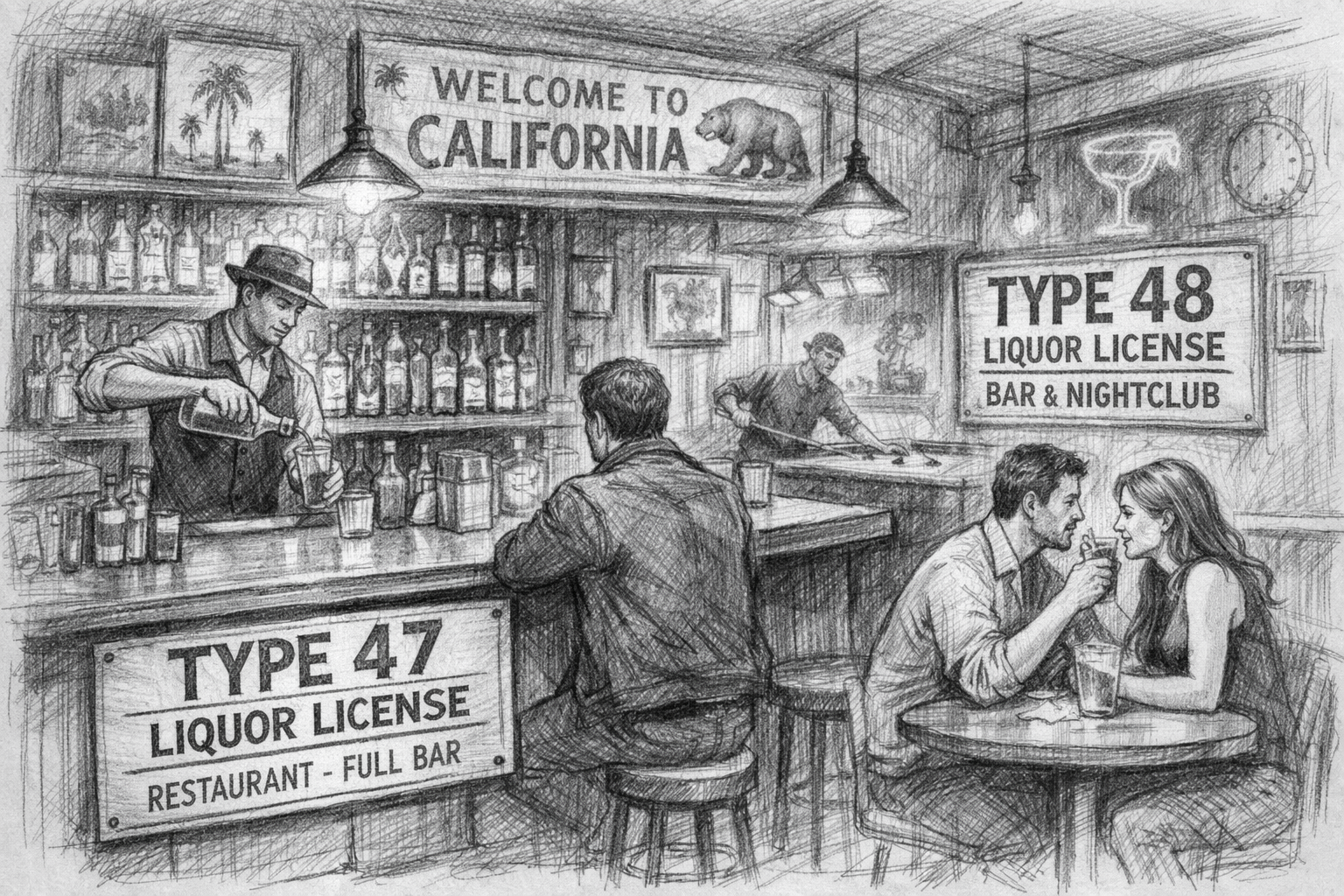
If you’re buying or selling a bar in California right now, the license attached to the deal may be worth more than the business itself.
That’s not hyperbole. In counties where Type 48 (On-Sale General: Public Premises) licenses are maxed out under California’s quota system, a single license can trade for $75,000 to $300,000+ depending on the county. And that scarcity is reshaping how every bar deal in the state gets structured.
The Quota System Creates Artificial Scarcity
California’s Alcoholic Beverage Control (ABC) issues two main on-sale liquor licenses for bars:
- Type 47 (On-Sale General: Eating Place): Full liquor service, but the establishment must serve food and derive meaningful revenue from it. Non-quota; the ABC will issue new ones as long as the applicant and premises qualify.
- Type 48 (On-Sale General: Public Premises): Full liquor, no food requirement. Quota-controlled, tied to county population, and no new licenses are issued once the quota is full.
In most Southern California counties, the Type 48 quota has been full for years. Los Angeles, Orange County, San Diego; if you want a Type 48, you’re buying it from an existing holder on the secondary market. And that secondary market has gotten expensive.
Why Premiums Are Climbing in 2026
Several forces are pushing license values higher right now:
Nightlife recovery is real. Post-pandemic bar revenue has stabilized, and operators are expanding again. More buyers chasing the same fixed supply of Type 48 licenses means prices go up.
The Type 47 workaround is getting crowded. Savvy operators have been sidestepping Type 48 scarcity by opening food-service concepts under Type 47 licenses: think cocktail bars with small plate menus, sports bars with kitchens, wine-and-tapas concepts. But ABC scrutiny on whether Type 47 holders are genuinely operating as “eating places” has tightened. If your food revenue doesn’t hold up to inspection, you risk license suspension.
County transfer restrictions add friction. Type 48 licenses can generally only transfer within the same county. A license holder in Riverside can’t sell to a buyer opening in San Diego. This fragments the market and creates county-level price variations that can differ by $100,000+.
What This Means for Sellers
If you own a bar with a Type 48 license in a quota-maxed county, your license is a standalone asset. When we value bar businesses, we’re increasingly separating the license value from the operating business value. In some deals, the license accounts for 30-40% of the total transaction price.
This gives sellers leverage:
- Even underperforming bars have a floor value because the license has intrinsic worth regardless of trailing revenue.
- Lease expiration isn’t the death sentence it is for restaurants. A bar owner whose lease is up can sell the license separately and walk away with six figures, something a restaurant operator with a Type 41 (beer and wine) can’t do.
- Timing matters. License values tend to dip slightly when economic uncertainty rises (fewer buyers) and spike when the bar market heats up. Right now, we’re in a rising market.
What This Means for Buyers
Buyers need to go in with clear-eyed expectations:
Budget for the license separately. Don’t look at a bar listing priced at $400,000 and assume $400,000 buys the business. It might be $150,000 for the license, $150,000 for the leasehold improvements and FF&E, and $100,000 for goodwill and trailing cash flow.
Consider the Type 47 path—carefully. If your concept involves food service anyway, a Type 47 license is significantly cheaper to obtain (ABC application fees, not secondary market premiums). But you need to genuinely operate as an eating place. Half-hearted food programs that exist only to satisfy ABC will catch up to you.
Look at underserved counties. Not every California county has a maxed-out Type 48 quota. Inland Empire, Central Valley, and some Northern California counties still have availability. If your concept is location-flexible, the license economics can be dramatically different.
The Broker’s Take
We’re advising bar sellers to get a current valuation that breaks out the license value explicitly. Buyers who understand the license economics negotiate better, and sellers who can articulate the license premium close faster.
The California bar market has always been license-driven. But in 2026, with nightlife demand up and quota supply fixed, the gap between license-rich and license-poor deals is wider than it’s been in years.
If you’re sitting on a Type 48 in LA, Orange County, or San Diego, you’re holding a depreciating-proof asset in a market that’s only getting tighter.
Smith Allen Group specializes in buying and selling bars and restaurants across California. If you’re evaluating a bar transaction and need help understanding the license landscape, get in touch.